

Conceptual inspiration for a house centred around a galley was drawn from the experience of our client’s life when they lived on board a narrowboat in the UK. Our clients loved that every aspect of their boat was highly considered, every space utilised.
This project speaks to two types of home-coming. The macro, coming home from living overseas with a broader perspective and experiences, and the micro, the daily rhythms and flow of coming and going from home.
Environmental consciousness starts with an understanding that the easier it is ride, the more we do it and this home is planned specifically to facilitate this. Ensuring every centimetre is utilised, avoids excess. Reuse of original building fabric minimises waste. New materials were selected for longevity and recyclability. Active and passive measures include solar and rainwater harvesting, considered orientation and ventilation.
This home is designed to expressly connect with our community through carefully graduated external and internal spaces. The design supports everyday interactions with the neighbourhood as a reminder that we are part of a greater whole, encouraging us to look outside of ourselves.
Topology acknowledge the traditional custodians of the land on which our studio stands. The Yalukit Willam people of the Boon Wurrung and the wider Kulin Nation. Each of us pay our deepest respects to the elders past, present and those emerging. We pledge our commitment in caring for this land and its first people. We promise to respect its history and continue to speak the truth.
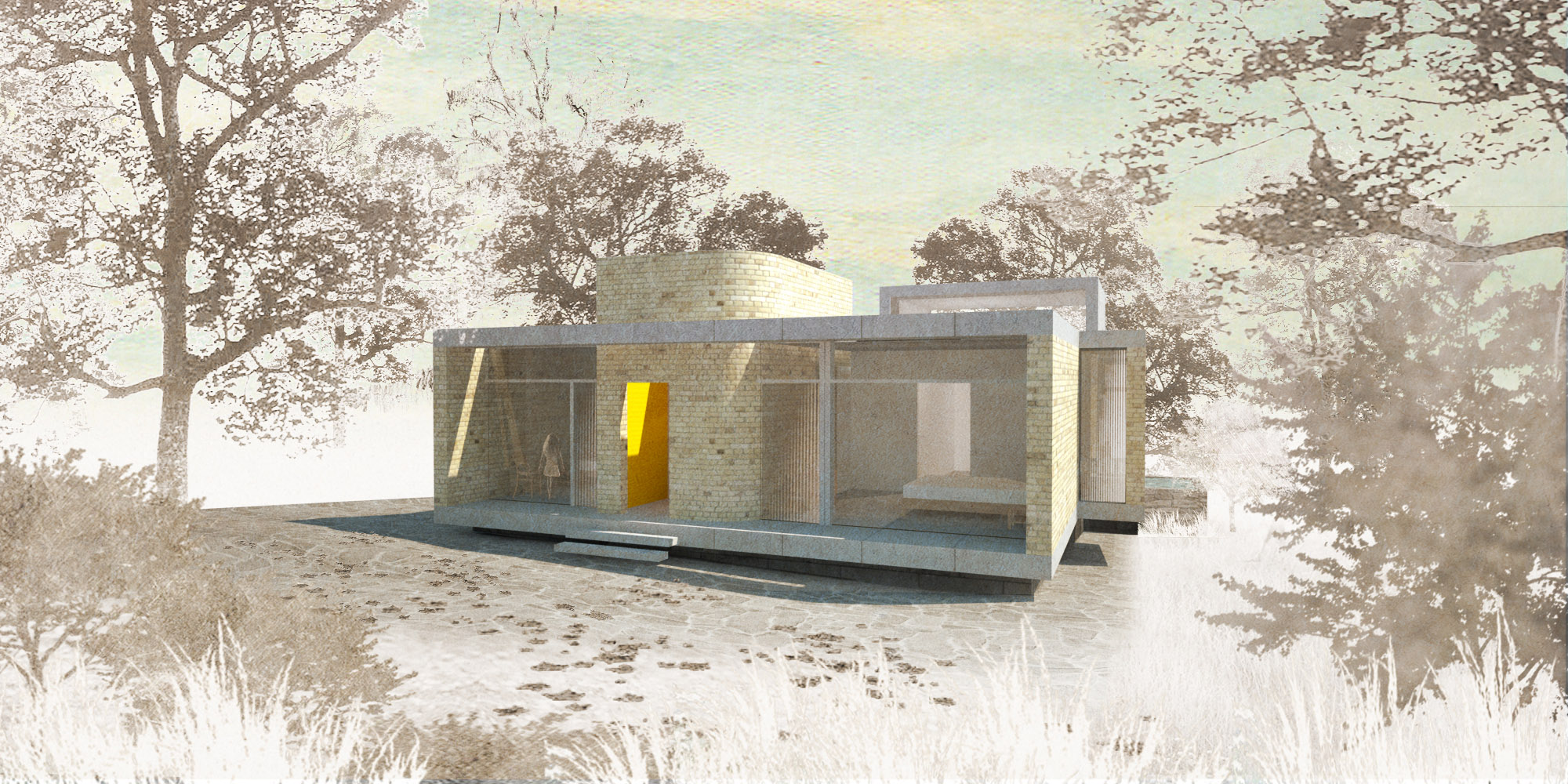
The design of this family house acknowledges the legacy of the brick homes that populate this established suburb in Melbourne’s east. The starting point for the design came from a series of drawings found in The State Savings Bank of Victoria’s Design Book: Housing Loan Conditions from 1941. This book contains “thirty designs of modern dwellings” by the bank’s in-house architect G. Burridge Leith – designs that shaped the suburban streetscape of this area.
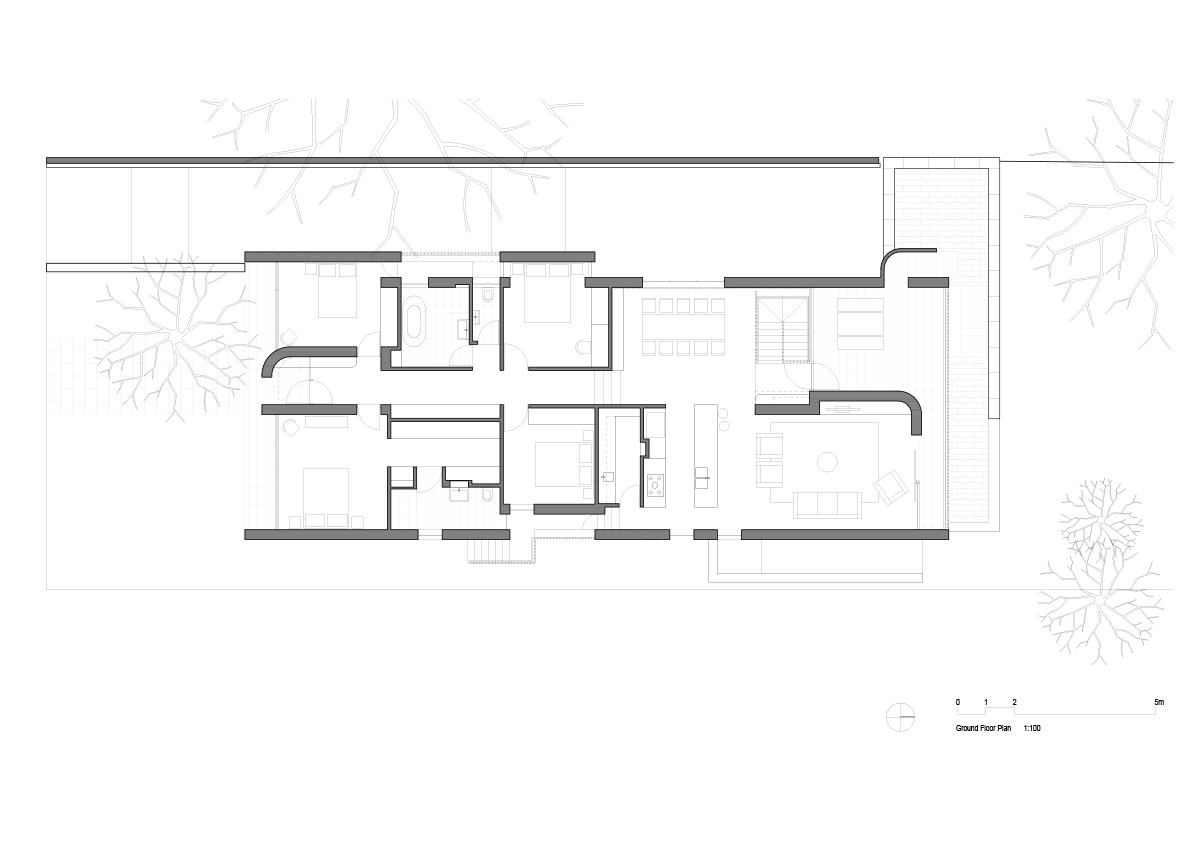
Rooms within the house are organised as simple boxes that slip past each other, creating a complex play of openings that draw light and ventilation into the centre of the house. Golden cream brickwork and raw concrete are used together with ribbed and clear glass to create a minimal yet warm palette that is coherent with and respectful of neighbouring houses. Within the boxes, curved brickwork achieves a sense of movement along the central hallway and lends a gentle asymmetry to the composition.
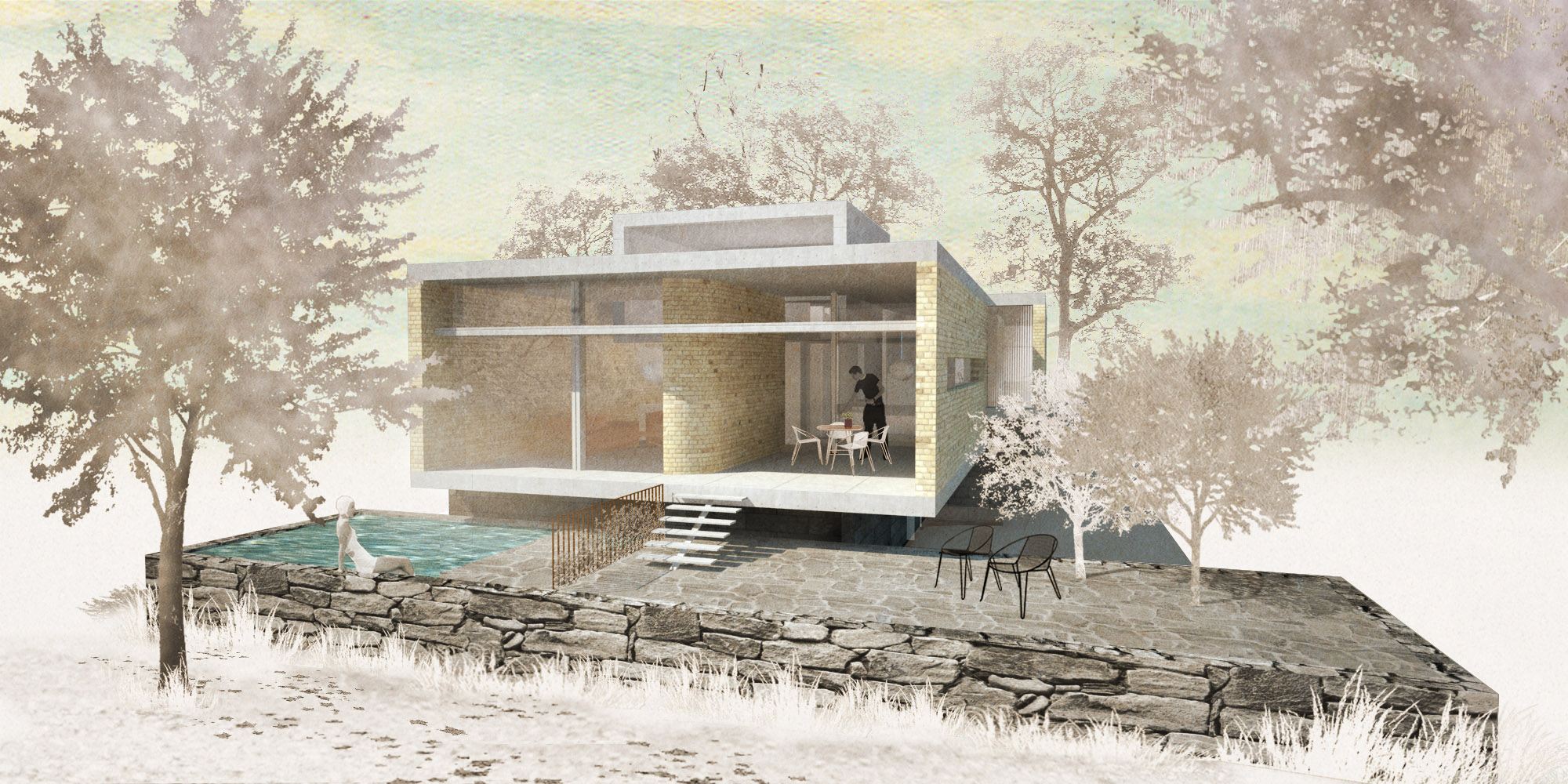
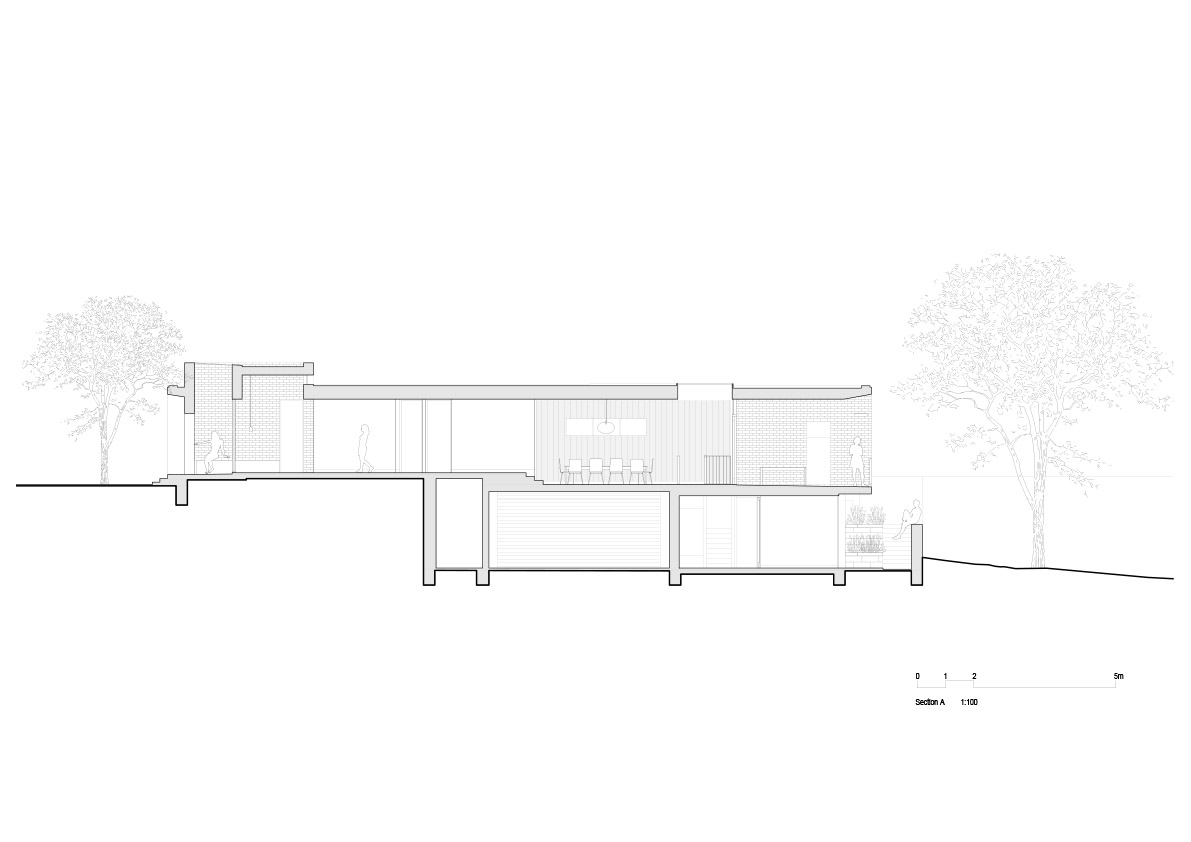
Spatially, the home responds to the steeply sloping block and the client’s brief for an elegant yet relaxed home that accommodates meals with a large extended family. A stepped plan allows the kitchen, dining and living rooms on the upper level to take advantage of the northerly aspect and calm treetop views, while a terrace on the lower level connects to the pool and the garden below.
The design of this family house acknowledges the legacy of the brick homes that populate this established suburb in Melbourne’s east. The starting point for the design came from a series of drawings found in The State Savings Bank of Victoria’s Design Book: Housing Loan Conditions from 1941. This book contains “thirty designs of modern dwellings” by the bank’s in-house architect G. Burridge Leith – designs that shaped the suburban streetscape of this area.
Rooms within the house are organised as simple boxes that slip past each other, creating a complex play of openings that draw light and ventilation into the centre of the house. Golden cream brickwork and raw concrete are used together with ribbed and clear glass to create a minimal yet warm palette that is coherent with and respectful of neighbouring houses. Within the boxes, curved brickwork achieves a sense of movement along the central hallway and lends a gentle asymmetry to the composition.
Spatially, the home responds to the steeply sloping block and the client’s brief for an elegant yet relaxed home that accommodates meals with a large extended family. A stepped plan allows the kitchen, dining and living rooms on the upper level to take advantage of the northerly aspect and calm treetop views, while a terrace on the lower level connects to the pool and the garden below.
The design of this family house acknowledges the legacy of the brick homes that populate this established suburb in Melbourne’s east. The starting point for the design came from a series of drawings found in The State Savings Bank of Victoria’s Design Book: Housing Loan Conditions from 1941. This book contains “thirty designs of modern dwellings” by the bank’s in-house architect G. Burridge Leith – designs that shaped the suburban streetscape of this area.
Rooms within the house are organised as simple boxes that slip past each other, creating a complex play of openings that draw light and ventilation into the centre of the house. Golden cream brickwork and raw concrete are used together with ribbed and clear glass to create a minimal yet warm palette that is coherent with and respectful of neighbouring houses. Within the boxes, curved brickwork achieves a sense of movement along the central hallway and lends a gentle asymmetry to the composition.
Spatially, the home responds to the steeply sloping block and the client’s brief for an elegant yet relaxed home that accommodates meals with a large extended family. A stepped plan allows the kitchen, dining and living rooms on the upper level to take advantage of the northerly aspect and calm treetop views, while a terrace on the lower level connects to the pool and the garden below.
This proposal for a temporary pavilion in the grounds of Melbourne’s National Gallery of Victoria (NGV) explores how an impermanent structure might be expressed in a fluid and temporal way.
The design references important moments in the NGV’s collection and its architecture to conceive an evocative and memorable site-specific installation.
A new gallery space is defined by walls of sheeting water. Willem de Kooning’s Standing Figure is enclosed within the walls. One-way glass mirrors on the ceiling and the end wall engage the viewer in a game of light, space and optical illusion, and re-present the sculpture in a new paradigm. The kinetic installation is intended to provide an emotional spatial experience that propels the audience to engage with the artwork and interact with the cascading water.
Architecturally, the installation mirrors the proportions of Roy Grounds’s Great Hall and draws inspiration from the enduring appeal of the water wall at the gallery entrance. It is also inspired by artworks from the NGV collection, including Bill Viola’s Ocean without a shore and Donald Judd’s Untitled (1969–71).
The Water Gallery is accessed using bright yellow umbrellas, creating a sense of joy and theatre through the audience’s interactions with both the gallery and the art that it holds.
On the lands of the Bunurong Boon
Wurrung people of the Kulin Nation.
Our Client’s Victorian terrace overlooks Nairm, Port Phillip Bay. Some mornings the bay is still, the lilac hue punctuated by bright jerseys of cyclists and lamps along the pier. This is Beaconsfield Parade at its most peaceful before the promenade fills with people strolling, paddling and driving. Later the wind rises, throwing waves onto the pier and foam onto the shore. At night stillness returns and lights of the shipping lane guide ships through the rip.
The brief was to reorganise the plan to improve light and outlook to the garden whilst providing a sense of entry from the lane. A single-storey, north-east facing pavilion is inserted below the existing building between the brick walls of the neighbouring terraces.
A stepped masonry wall forms a kind of lantern adjacent to an existing brick wall. Inside the plywood ceiling sweeps up, enabling light to fall deep into the floor plate. The volume created provides a high gallery wall whilst the rest of the addition is level with the adjacent boundary walls.
The lantern is the only part of the addition visible from outside of the property. This discrete intervention has improved the environmental performance of the home without compromising the heritage values of the place. The lantern is a welcoming engagement with the lane and surrounding built landscape.
Commendation – Residential Dwelling: Alteration/Addition
The Design & Development Awards, City of Port Phillip, 2022
